
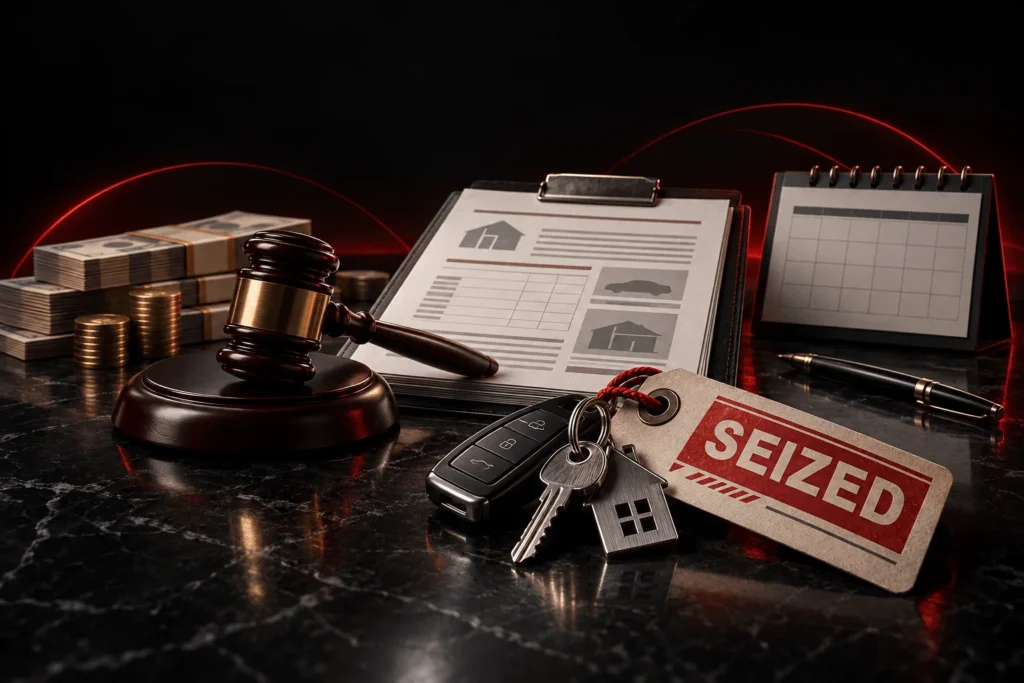
Revoking property attachment (asset seizure)
First consultation free of charge (Mon–Fri, 9:00–18:00)
Call +380 (97) 158-30-28Seizure of assets restricts the right to dispose of property and often affects people who are not parties to the proceedings at all. The law provides a procedure for having that restriction reviewed.
When to get in touch
- real estate, vehicles, equipment or goods have been placed under seizure
- the seizure affects property belonging to a third party
- the grounds on which the seizure was imposed no longer exist
- the value of the property seized clearly exceeds what the case requires
Recognise your situation?
First consultation free of charge (Mon–Fri, 9:00–18:00). The fee for further work is agreed in writing before it begins – how we calculate fees.
What the lawyer does
- studies the ruling on property attachment and the motion on which it was made
- establishes who owns the property and gathers the title documents
- prepares a motion to revoke the property attachment
- argues that the grounds for seizure never existed or have fallen away
- represents the owner at the hearing of the motion
- prepares an appeal against the ruling where needed
When a property attachment can be revoked
An attachment is revoked in full or in part where it is proved that there is no need for continued application of this measure or that the attachment was ungrounded. The motion may be filed by the suspect or accused, their defence counsel or legal representative, another owner or holder of the property, or the representative of the legal entity in whose respect proceedings are taken (part 1 of Article 174 of the Criminal Procedure Code of Ukraine).
- during the pre-trial investigation the motion is heard by the investigating judge, and during court proceedings by the court (part 1 of Article 174)
- it must be considered within three days after it reaches the court; the person who filed it is told when and where it will be heard (part 2 of Article 174)
- when the prosecutor closes the criminal proceedings, the prosecutor revokes the attachment at the same time unless the property is subject to special forfeiture (part 3 of Article 174) – see closing criminal proceedings
What the court must take into account
- the legal basis for the attachment and, where property is attached as evidence, whether it can actually be used as evidence (part 2 of Article 173)
- the reasonableness and commensurability of restricting the right to property with the objectives of the proceedings, and the consequences of the attachment for the suspect and third parties (ibid.)
- the court uses the least onerous method of attachment – one that does not result in the suspension or excessive restriction of lawful business activities (part 4 of Article 173)
- property owned by a bona fide purchaser cannot be attached, except to preserve physical evidence (part 10 of Article 170)
- people lawfully living in a residential property may not be banned from using it (part 12 of Article 170)
Appealing the attachment ruling
A ruling of the investigating judge on the attachment of property may be challenged on appeal (clause 9 of part 1 of Article 309) within five days from the date of its pronouncement. If the ruling was made without summoning the person who appeals, the period runs from the day that person receives a copy (parts 2 and 3 of Article 395).
Legal basis
Property attachment (often called asset seizure) is governed by Article 170 of the Criminal Procedure Code of Ukraine; its revocation is governed by Article 174.
Legislation and case law are updated over time; this page reflects the position as of November 2026.
Frequently asked questions
Who can apply to have a property attachment revoked?
A suspect, an accused, their defence counsel or legal representative, another owner or holder of the property – including someone who is not a party to the proceedings – and the representative of the legal entity in whose respect proceedings are taken (part 1 of Article 174 of the Criminal Procedure Code).
How long does it take?
The investigating judge or the court must consider the motion within three days after it is received by the court (part 2 of Article 174 of the Criminal Procedure Code). During the pre-trial investigation the motion is considered by the investigating judge, and during court proceedings by the court.
How long is there to appeal the attachment ruling?
Five days from the pronouncement of the investigating judge’s ruling; if it was made without summoning you, from the day you receive a copy (parts 2 and 3 of Article 395 of the Criminal Procedure Code).
Can the property of someone who is not a suspect be attached?
Yes, in the cases set out in Article 170 of the Criminal Procedure Code. For example, to preserve physical evidence, the property of any individual or legal entity may be attached where there are sufficient grounds to believe that it meets the criteria in Article 98 (part 3 of Article 170). The owner may file a motion to revoke the attachment (part 1 of Article 174).
Need legal assistance? Call us or leave a request – a lawyer will contact you and explain what to do in your situation.
How we work
-
You submit a request
-
We analyse your situation
-
We agree a strategy with you
-
We protect your interests


Similar services
-
2020
year founded
-
9
attorneys on the team
-
11
practice areas
-
24/7
urgent legal assistance
Useful articles


Successful cases
-
 Won
Protecting victims: defendant sentenced to 5 years, damages awarded to our clients
Two clients suffered grievous bodily harm. The defendant was sentenced to 5 years, and UAH 264,498.22 was awarded to the victims.
-
 Won
Case under Article 369(3) of the Criminal Code closed as the investigation period expired: upheld by the Supreme Court
The indictment reached the court after the investigation period had expired. The case was closed under Article 284(1)(10) CPC; the Supreme Court agreed.